


Frescoes of the first Piano Nobile
Palazzo Lomellino houses one of the very few fresco cycles by Bernardo Strozzi to have survived to this day. An extraordinary Genoese pictorial episode from the early seventeenth century, rediscovered in 2004.
Around 1618 Bernardo Strozzi—called ‘il Cappuccino’ because he was a member of the religious Order of the same name—received from Gio. Stefano Doria the commission to fresco a room on the ground floor of the Palazzo Branca Doria in Piazza San Matteo, now unfortunately rendered illegible due to damp. This was the painter’s first fresco commission; he was subsequently called upon to decorate the vault of the choir in the Genoese church of Santi Tomaso e Domenico, destroyed in the nineteenth century, on whose site the Teatro Carlo Felice was later built.
Very little of the grandiose work was preserved—a fragment of fresco is displayed at the Museo dell’Accademia Ligustica di Belle Arti—but its composition is known thanks to the detailed sketch exhibited at the same museum.
Strozzi’s fee was indeed high and only wealthy and rich patrons could afford to commission works from him: it is no coincidence that the very wealthy Filippo Centurione turned to the painter and entrusted him with the fresco decoration of three vaults in the Palazzo Centurione-Carpaneto in Sampierdarena, the best-preserved example in the city before the fortunate discovery of the frescoed ceilings on Strada Nuova.
Luigi Centurione (1597–1659) in 1623 commissioned Strozzi to decorate the grand staircase, the loggia and, on the first piano nobile, the vaults of three rooms and two small chambers in the palazzo recently acquired from the Lomellino family on the elegant sixteenth-century street.
Strozzi was supposed to complete the commission in eighteen months, but, on 24 November 1625, in a document addressed to the Senate of the Republic, the artist himself complained of having toiled well beyond the agreed terms and of not yet having been adequately paid. Centurione, without letting even a day pass, responded to the provocation by accusing Strozzi of not having respected the contractné nei tempi, né nel lavoro, né per altra cosa”: “…doveva in 18 mesi che cominciorno a 23 agosto 1623 haver dipinto tre camere nell’appartamento da basso e duoi recamerini e la scala et hoggi non ha fatto altro che dipingere le volte delle stanze et non ha neanco principiata la pittura della scala…”.
A well-documented legal dispute ensued, which led to the abrupt interruption of the fresco decoration, thus limited to just the first three rooms originally planned: of these, in the two lateral rooms the ceiling decorations were chipped away and whitewashed, probably at Centurione’s direct wish, while the frescoes in the central room pleased the patron, who chose to preserve them.
At the beginning of the eighteenth century, to give greater prestige to the second piano nobile, the Pallavicini had the staircase connecting it to the first floor enlarged, and this operation involved raising a new load-bearing wall that effectively reduced the space of the central room, which was consequently given a false ceiling.
The extraordinary discovery in 2004 of Strozzi’s fresco still intact is due to an intuition of Mary Newcome and Beppe Merlano: by making an investigative hole in the vault it was possible to identify and thus recover what the artist had painted, extraordinarily preserved thanks to the reed-mat false ceiling.
CENTRAL ROOM: ‘FAITH LANDING IN THE NEW WORLD’”
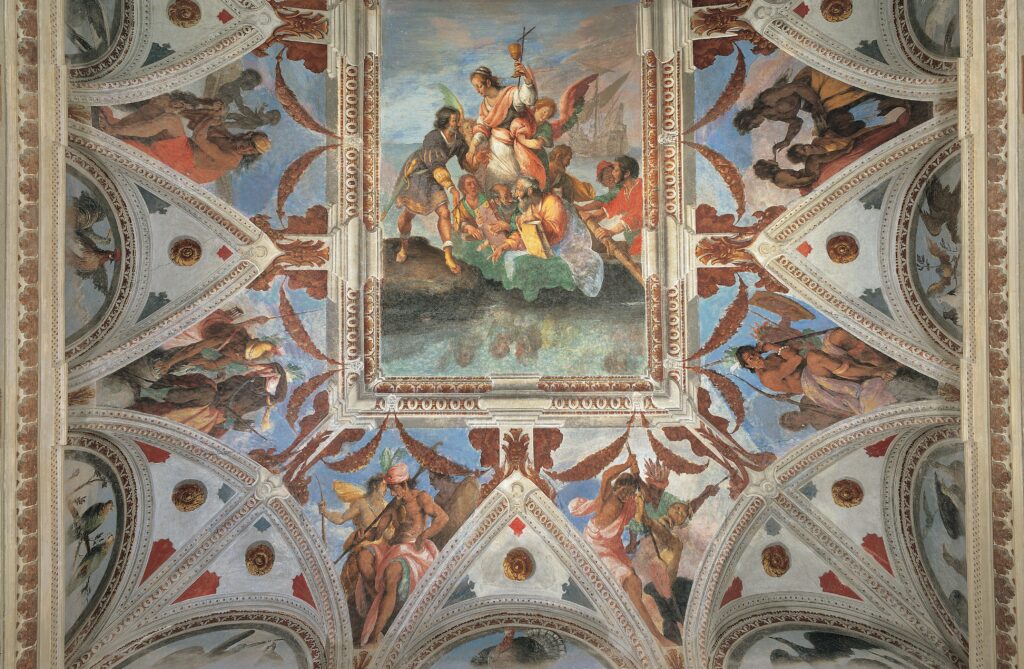
For visitors and for Genoese residents alike, the sight of these lively and most delightful creations by Strozzi is deeply moving—frescoes long hidden and thought to be lost forever.
The particular iconographic choice is also certainly of great fascination: in the central scene of the vault—framed by a faux stucco border according to the traditional ‘quadro riportato’ scheme—a male figure is depicted helping a young woman, an allegory of Christian Faith, to descend from a boat onto dry land.
The gentleman, standing and already ashore, holds an astrolabe in his hand that identifies him as a navigator, while Faith, accompanied by two angels, stands out as the visual and symbolic focal point, holding aloft a golden chalice surmounted by a cross.
According to Newcome’s interpretation, the four elderly figures depicted beside Faith, holding fine bound texts in their hands, would represent the four Evangelists, and the scene should be read as an allusion to the discovery of the Americas in 1492. This image would thus serve, according to the scholar, to evoke the ancient friendship between Christopher Columbus and the Centurione family, who in 1478–1479 had turned precisely to the great navigator to obtain from Madeira a good quantity of sugar to sell in the Ligurian city.
The discovery of the Americas had already been celebrated in the city by Lazzaro Tavarone, in 1607, in a now-destroyed room of Villa Saluzzo Bombrini ‘il Paradiso’ and, probably within the second decade of the seventeenth century, in Palazzo Belimbau—precedents to which Strozzi undoubtedly looked.
This theme, certainly agreed upon with Luigi Centurione himself, allowed the painter to indulge in curious, imaginative subjects, enlivened by brilliant and iridescent colours. In the lunettes, birds—including exotic ones—alternate, not only the fruit of the painter’s imagination but certainly derived from prints and reproductions of real images, a fact not unusual considering that Genoa and Antwerp in the sixteenth century were the most important centres for the bird trade. In the pendentives, however, there are scenes of hunting and labour by the Indios, scenes of bloody cannibalism alongside sweet images of maternal love, all linked to the indigenous world.
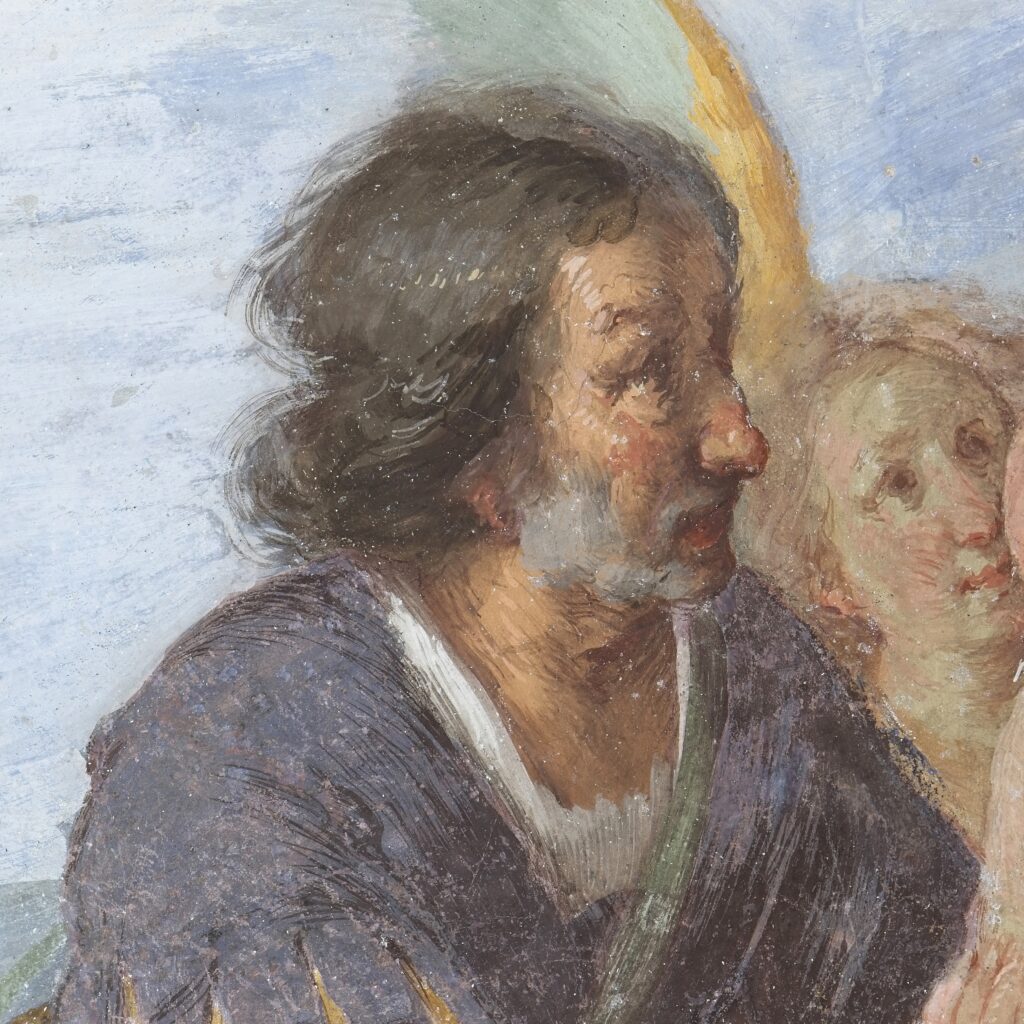
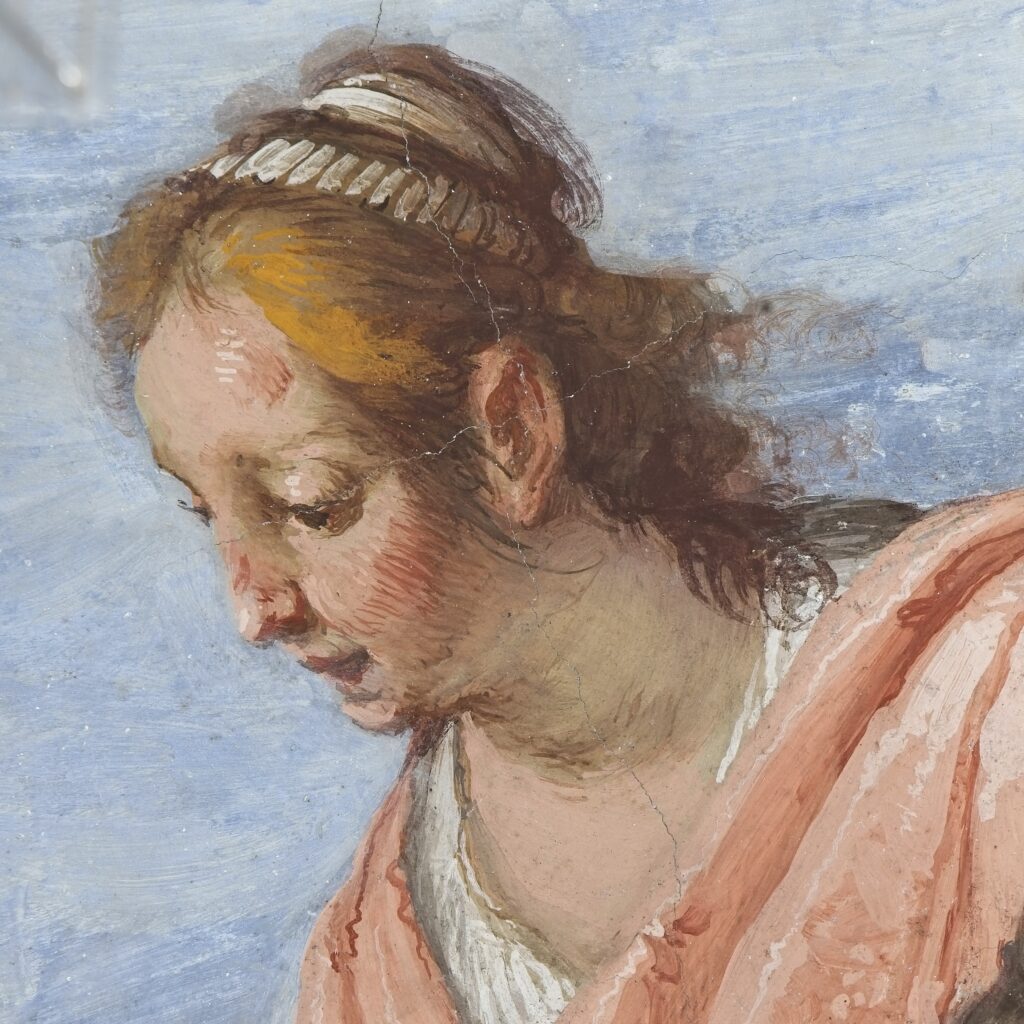
Here the painter demonstrates his ability to apply colour with lively and vibrant brushstrokes, in rapid dry strokes laid onto the already dried fresco, showing his skill in employing a mixed technique, following a practice that had by then spread to Genoa as well thanks to the example of Perin del Vaga in the palazzo of Andrea Doria.
Francesca Boschieri Centurione (2004) has usefully recalled that a Centurione had financed Columbus’s voyages to the New World and that the family’s heraldic motto was ‘Sola fides sufficit’—‘Faith alone suffices’—an expression that effectively constitutes an excellent synthesis of the entire representation. According to this reading, the gentleman in classical attire could be a member of the Centurione family itself, whose colours he wears in his garment, presented here as a defender of the Church.
THE ASTROLOGY ROOM
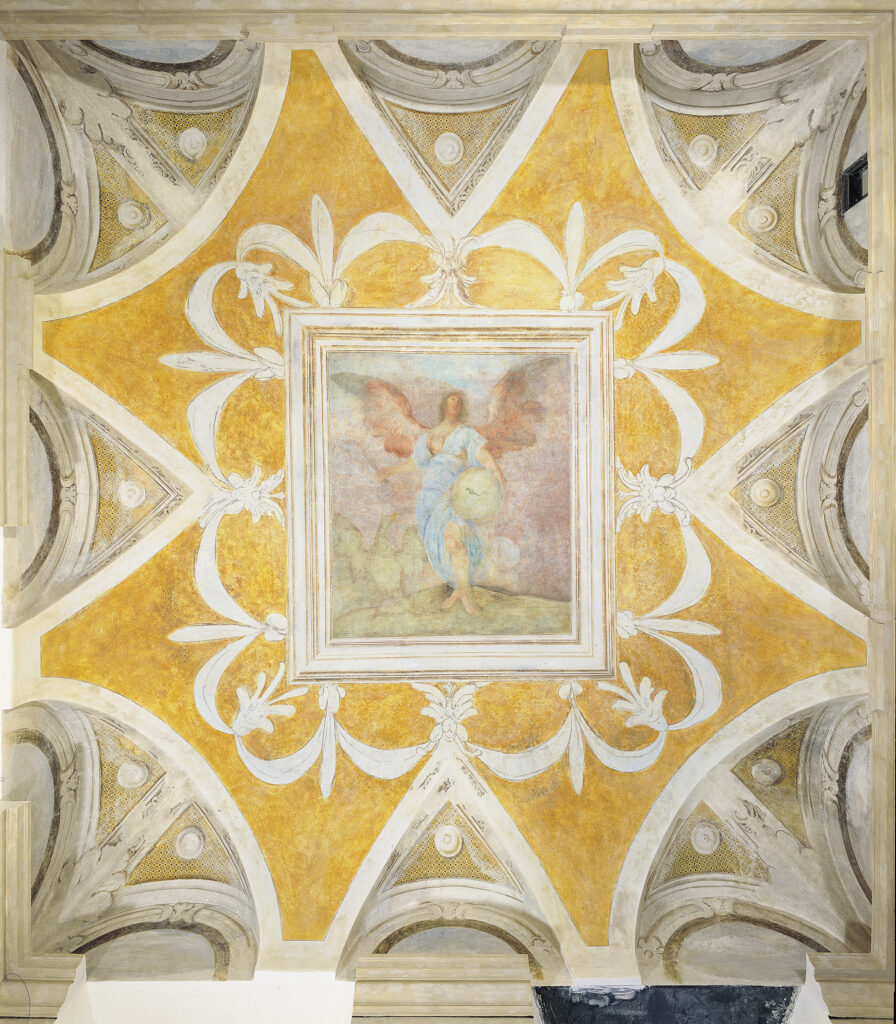
This room is the only one of the three overlooking Strada Nuova to have maintained its original dimensions unchanged. At the centre of the ceiling a female figure with wide red wings faintly emerges, with an eagle at her feet: this fresco is among thosescancellati“—as the archival documents state—at the wish of Luigi Centurione, and concealed by many layers of plaster that have visibly compromised its preservation. The woman holds in one hand a celestial sphere with a hydra at its centre and in the other a compass, emblems that, according to Ripa’s codification, are the attributes of Astrology; thus in this room too the references to navigation and its instruments continue. The figure is framed by a large white festoon garland on an ochre-yellow base: here the execution was not completed, thus leaving the exceptional opportunity to glimpse traces of squaring and black chalk from the preliminary drawing.
THE ROOM OF THE "FRAGMENTS"
On the vault of this room two fragmentary frescoed scenes are now visible, credibly attributable to two distinct but almost contemporary pictorial phases; the incompleteness of this decoration is probably explained by the aforementioned dispute between painter and patron.
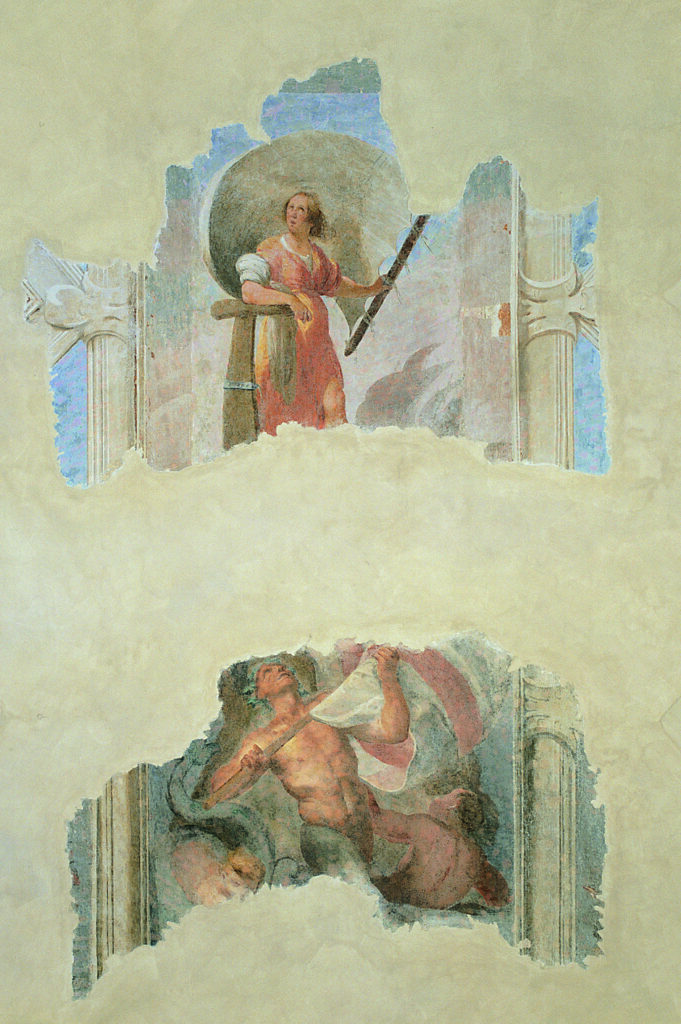
On the side facing Strada Nuova, a first fragment can be identified depicting a woman holding a rudder and a boom with a sail billowing in the wind; a second fragment instead represents a triton holding a large white and red standard, the crossed coat of arms of the Republic of Genoa. Between the two fresco sections a notable difference in execution is evident: the female figure closely follows Strozzi’s compositional and physiognomic modules, while the triton, for"la potenza muscolare del torso ed il modellato più denso e compatto"has led Newcome (2004) to hypothesise the intervention of a second hand, perhaps that of Gioacchino Assereto, already a collaborator of the Cappuccino in the early 1620s.
The lunettes are decorated with vegetal and natural motifs, perhaps the work of the northern landscape painter Goffredo Waals, a subtenant in those years of Strozzi in the dwelling that the Genoese painter had in turn rented, in San Siro, from the Centurione family. On the side towards the alley, a small ‘pregadio’ (private oratory) with Rococo decorations has been found, carved into the wall during the eighteenth-century interventions.