


The History of the Palace
Built in the 1560s, the Palazzo has seen several families succeed one another as owners, becoming a protagonist, over the centuries, of the evolving tastes and styles of its different occupants.
The Palazzo was built at the behest of Nicolosio Lomellino between approximately 1563 and 1569, designed by the Lombard architect Giovanni Battista Castello, known as "il Bergamasco".
In 1550, to meet the needs of several Genoese aristocratic families, a new thoroughfare was designed – today's Via Garibaldi – to connect the medieval centre with the eastern areas, thus giving rise to a new quarter of magnificence.
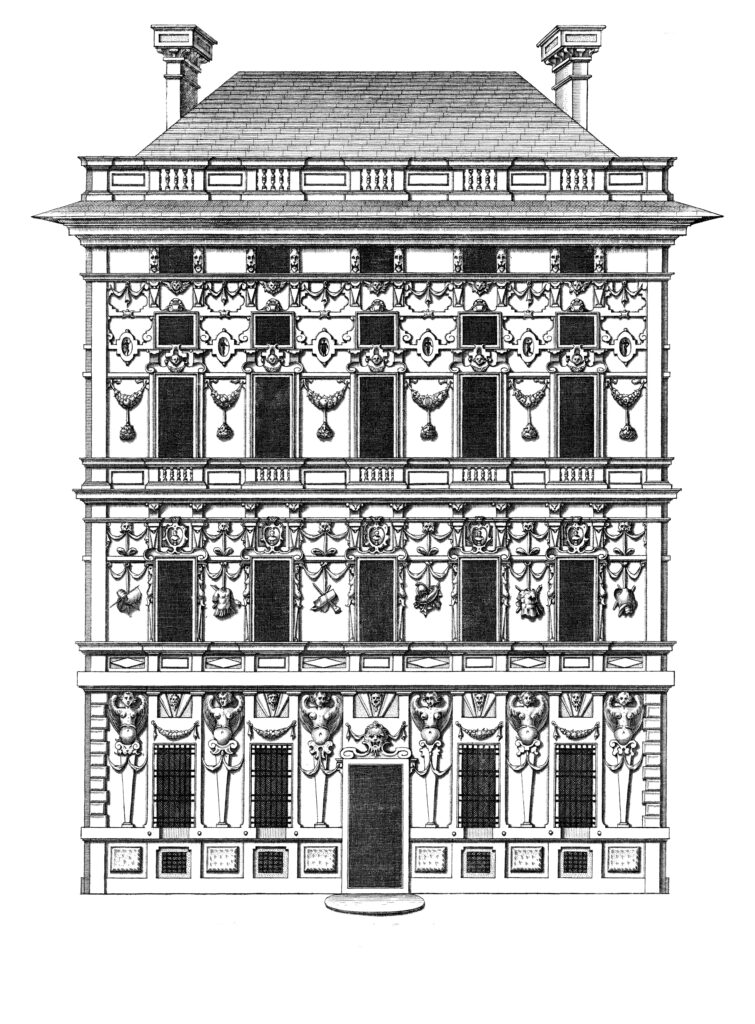
from Palazzi Moderni di Genova, 2nd ed., Antwerp 1626
The ancient 'Strada Nuova dei Palazzi' effectively became an elite district, where the city's aristocracy, satisfying their desire for self-celebration, competed in commissioning elegant residences from the most important architects of the time, who were able to experiment here with innovative and up-to-date solutions.
The plot on which our building stands, public land formerly belonging to Luca Grimaldi, had initially been purchased by the Gentile family in 1559, during the first public auction of the land; it then passed to the Lomellino family in 1563, who immediately began construction work. The patron Nicolosio Lomellino had amassed a considerable fortune by investing, together with his brother Francesco, in the lucrative coral fishing trade on the Tunisian island of Tabarca.
According to Pesenti's latest reconstruction, the Palazzo was purchased in December 1609 by Luigi Centurione, while the transfer to the Pallavicini family has been correctly dated by the present author to 1711, thanks to the discovery of new archival documents (Manzitti, Priarone, forthcoming). After a brief period of ownership by the Raggi family, in 1865 Baron Andrea Podestà, a prominent figure in Genoa at the time and three-time mayor of the city, acquired the property, which through direct descent has come down to the current owners.